
The Handoff: Why the Best Tier 1 Support Runs on AI and Humans
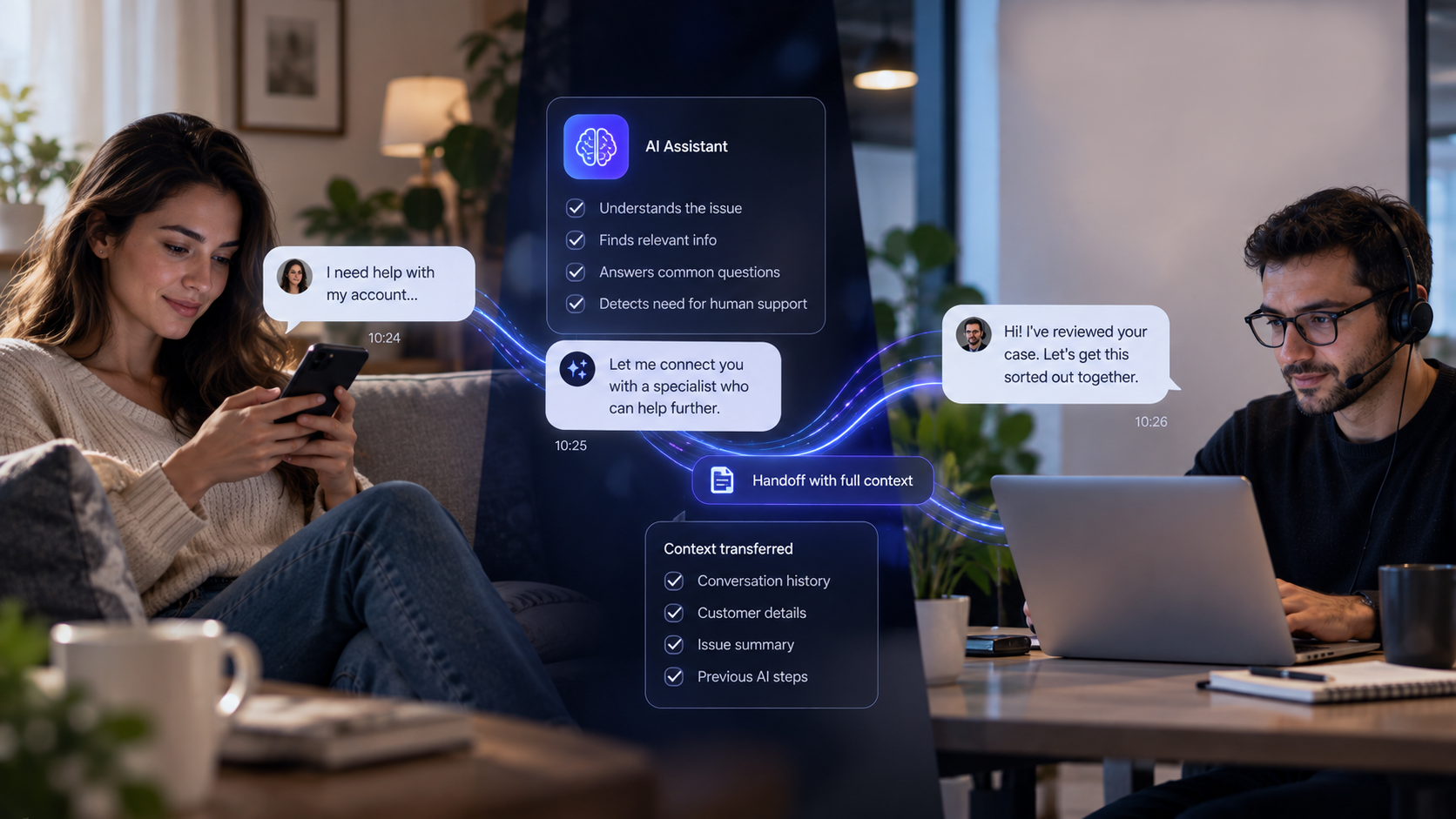
Every support leader has heard the same pitch: deploy AI, watch tickets disappear. And for a real slice of tier 1 volume, it's true — a password reset or an order-status question can now be answered in seconds, at any hour, with no queue. But the pitch usually stops there, right before the part that actually determines whether customers stay happy: what happens the moment AI can't solve it.
That moment is the handoff: the point where an AI agent passes the conversation to a human agent. Done well, the human sees the entire conversation instead of a summary that starts from zero, so the customer never has to repeat themselves.
What AI is genuinely good at on tier 1
The honest numbers are lower than the demos suggest, and that's fine — because they're still substantial. Across enterprise support programs, median tier 1 deflection sits at 41.2%, with the top quartile reaching 58.7% (Zendesk CX Trends, Salesforce State of Service, 2026). That average hides a wide split: highly structured requests with a clear system of record behind them — password resets, order status, account updates — deflect at 65–80%. Anything sentiment-heavy or dispute-shaped stays in the 20–35% range, no matter how good the model is.
The economics behind that gap explain why it's still worth doing. Industry benchmarks put AI cost-per-resolution at roughly $0.62 versus $7.40 for a human-handled ticket — chat as low as $0.41, voice-AI around $1.18 (McKinsey AI in Customer Service, 2026). When even 40% of tier 1 volume shifts to that cost structure, the savings are real before a single human hour changes.
Where it breaks: the loop nobody wants to be stuck in
Almost everyone has been the customer stuck rephrasing the same question to a bot that won't budge, asking for a human, and getting redirected back into the same script. That experience isn't a minor UX flaw — it's the single fastest way AI erodes trust it took years to build. And the data backs up why: pure-AI handling lands around 4.1 out of 5 on CSAT versus 4.3 for human agents — a small gap on paper, but one that widens fast whenever a customer feels trapped rather than helped (Intercom Customer Service Trends, 2026).
The failure mode is almost always the same: a team measures success by how few tickets reach a human, not by how many problems actually get solved. A ticket that closes because the customer gave up looks identical, on a deflection dashboard, to one that closed because the issue was fixed. Optimizing for the wrong number is how "AI-first" support quietly becomes "AI-only" support by accident.
What a good handoff actually looks like
The fix isn't less AI — it's a tier 1 model built around the handoff, not around avoiding it:
- Confidence-based routing. The AI resolves what it's genuinely sure about and hands off the rest immediately — instead of forcing a close on a question it can't actually answer.
- Full context on every handoff. The human agent sees the entire conversation, not a summary that starts from zero. Nothing is more frustrating than repeating yourself to a person after already explaining it to a bot.
- AI stays useful after the handoff. The best setups don't switch AI off once a human takes over — they use it to suggest replies, surface the right knowledge-base article, and summarize the thread, cutting agent handle time by an estimated 35–45% on escalated tickets (Gartner, 2025).
- Measure resolution, not just deflection. The number that matters isn't how many tickets avoided a human — it's how many stayed solved. Re-contact rate within 72 hours already runs higher on AI-resolved tickets than human-resolved ones (11.3% vs. 8.7%), which is exactly the gap a good escalation model is built to close.
Chat today, voice close behind
Most of this has lived in chat so far, but voice is catching up fast. AI voice agents handling after-hours calls and routine bookings moved from experimental to production through 2026, following the same logic as chat: structured, high-confidence calls get resolved instantly; anything ambiguous, emotional, or high-stakes routes to a live agent — ideally with the call context already attached, not a re-introduction from scratch.
How Evateck runs it
This is exactly the model we build for tier 1 in our customer support outsourcing services: AI handles the instant, repetitive chat and voice volume, and hand-picked, trained human agents own tier 2 — escalations, complexity, anything that needs judgment or empathy. Every handoff carries full context, so no customer repeats themselves. It runs inside your existing helpdesk and AI tooling, with your organization keeping ownership of what the AI is allowed to say, across 40+ languages, ISO 27001-aligned and GDPR-ready, live in under two weeks. For the round-the-clock side of the same model, see why 24/7, multilingual support became the baseline for growth.
Because the goal was never fewer tickets reaching a human. It was fewer customers left waiting for one — and a fast, correct handoff every time they actually need it.
It's the same principle we cover in Automation Meets Empathy: the best support isn't automation instead of people — it's automation that knows when to step back.
Sources: Zendesk CX Trends 2026, Salesforce State of Service 2026, Intercom Customer Service Trends 2026, McKinsey "AI in Customer Service" 2026, Gartner (2025–2026).
Related posts

Get insights from our team
Once a month, no spam. Operational playbooks, case studies, and CX trends.