
Build vs Buy: When an In-House Support Team Costs More Than You Think
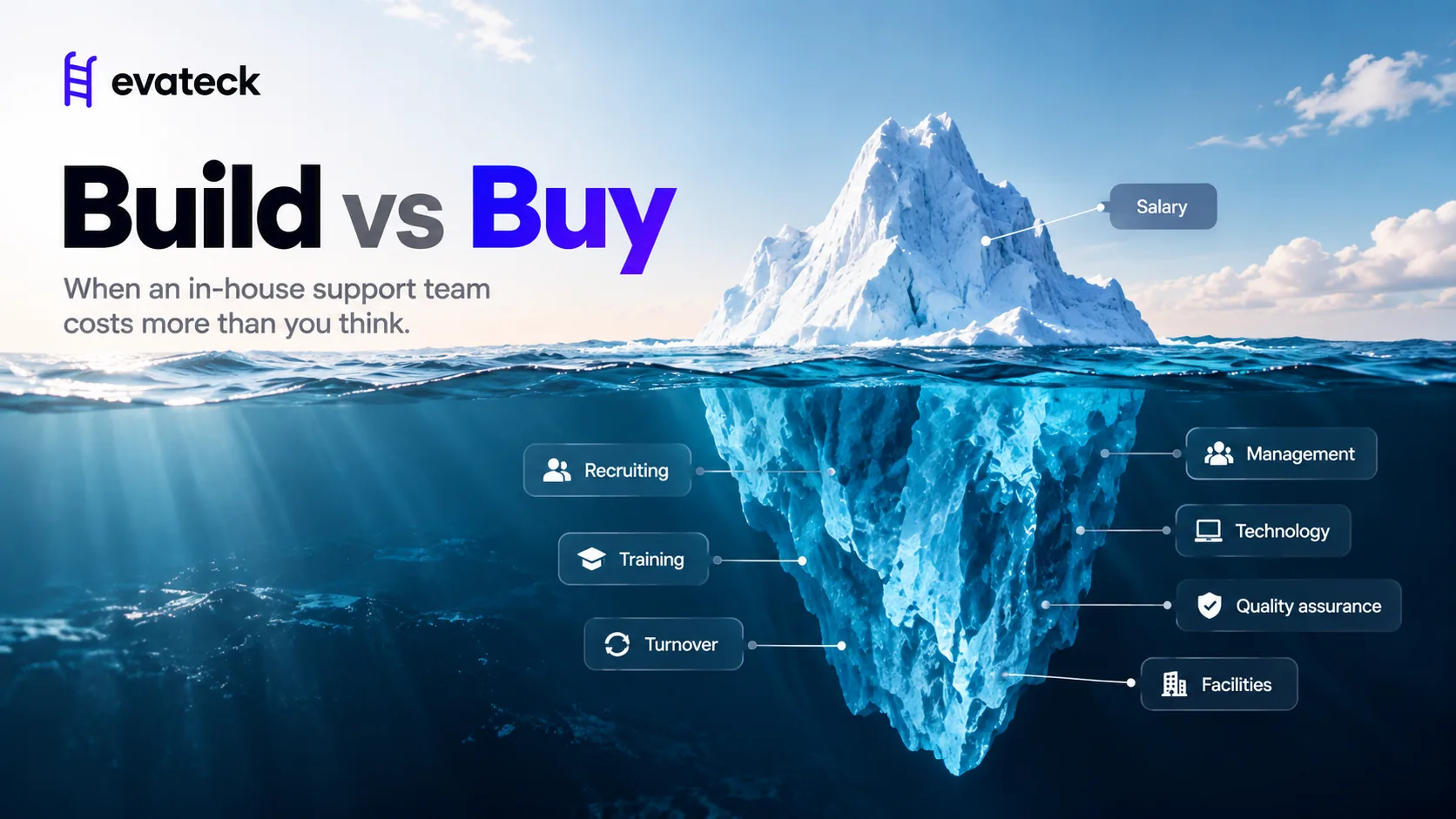
When support volume starts to hurt, the instinct is almost always the same: hire. Post the roles, build the team, keep it close. It feels like the safe, controllable choice — you own the people, you own the quality. But the number on the offer letter is the smallest part of what an in-house support team actually costs. The rest shows up later, quietly, month after month.
The sticker price is the cheap part
Salaries are the visible line item. The expensive ones are hidden: recruiting, training, quality assurance, scheduling, management, technology, and the productivity you lose every time a seat turns over. Support isn't a role you hire once — it's an operation you have to keep running. And that operation has a leak most companies badly underestimate.
What turnover actually costs
Customer support has one of the highest churn rates of any function. Annual agent turnover runs 40–45% in 2026, and average tenure sits at just 14 months (QATC, Insignia Resources). First-year attrition is worse still — in many centers, 65–70% of new hires are gone within twelve months.
Every one of those exits is a bill:
- Replacing a single agent costs $10,000–$20,000 in direct expenses — and up to roughly $46,000 once lost productivity during ramp-up is counted (Insignia Resources).
- The average cost-per-hire across industries is about $4,683 (SHRM), before a minute of training.
- New agents need around four weeks to ramp — and roughly a third of all turnover happens in the first 90 days, meaning you often pay to recruit and train people who leave before they ever pay off.
Run the math on a 100-seat operation at industry-average turnover and you're looking at $400,000 to $800,000 a year spent on churn alone — money that buys you no new capacity, just a treadmill.
It's not only money — it's consistency
The financial cost is only half the damage. A customer who called in March talks to a different, newer agent in June. Product knowledge walks out the door with every departure, first-contact resolution dips during high-turnover months, and CSAT slips right when you can least afford it. Meanwhile 87% of agents report high stress and 74% report ongoing burnout (Insignia Resources) — and managers in high-churn centers spend up to 20% of their time interviewing instead of coaching. You don't just lose people; you lose the momentum that makes support good.
Where outsourcing changes the equation
The reason a BPO partner can be cheaper isn't just labor arbitrage — it's that you stop buying headcount and start buying an operation. Recruiting, training, QA, scheduling, coverage, and retention become someone else's problem to solve at scale:
- Turnover is absorbed, not inherited. When an agent leaves, a trained replacement is already there. The churn cost sits with the partner, not your P&L.
- Coverage comes built in. 24/7, multilingual, follow-the-sun support without you staffing three shifts across time zones.
- You flex both ways. Scale up for peak season and back down after — no hiring sprint, no layoffs.
- The economics are different. Onshore in-house seats run $25–45 per loaded hour; outsourced models land far lower, without the overhead of building the machine yourself.
The global contact-center outsourcing market reached roughly $97 billion in 2026 and is still growing at nearly 10% a year (Grand View Research) — largely because these numbers keep pushing companies to the same conclusion. For the commercial side, see outsourced support pricing.
So when should you build?
Outsourcing isn't the answer to everything, and honest advice matters more than a hard sell. Keep in-house the work that defines you: deep product expertise, high-touch enterprise accounts, anything that is your core competitive edge. Buy the parts that scale linearly with volume and burn out your team — tier 1–2 support, after-hours coverage, peak overflow, multilingual queues. The best setups are often hybrid: a lean internal core, with a partner running the operation around it.
The Evateck approach
This is exactly the operation we're built to run. At Evateck, we own the whole machine — hand-picked, trained agents; QA; performance tracking; and the retention work that keeps quality steady — embedded in your tools and your tone as shared or dedicated teams. Everything runs 24/7 in 40+ languages, ISO 27001-aligned and GDPR-ready, live in under two weeks. The result: clients typically see 80% lower costs, 60% faster response times, and 33% higher CSAT — the capacity of a full team without the treadmill of building one. See the Amberley Innovations case study.
Because the real question was never "should we own our support team?" It's "should we own the cost of running it?" — and increasingly, the smartest companies are choosing to own the outcome instead.
Sources: QATC, Insignia Resources, SHRM, Grand View Research, U.S. Bureau of Labor Statistics, Call Force Global (2025–2026).
Related posts


Get insights from our team
Once a month, no spam. Operational playbooks, case studies, and CX trends.