
Outsource the Work, Not the Risk: What to Verify Before You Trust a BPO With Your Data
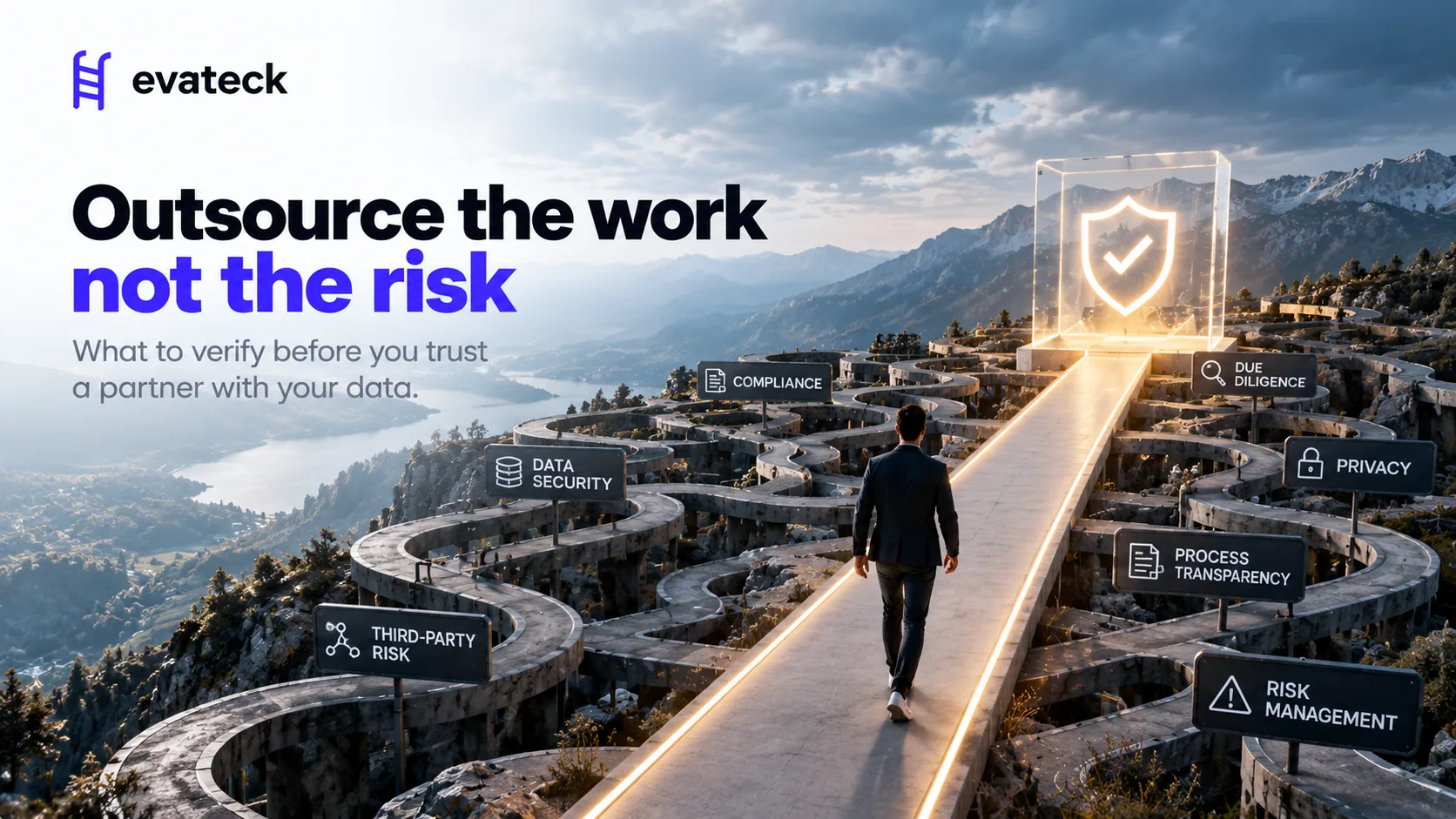
Most outsourcing decisions come down to two questions: will it cost less, and will the quality hold? There's a third question that rarely makes the shortlist — right up until it's the only one that matters. When your BPO partner handles your customers' payment details, identities, and personal records, their security is your security. And your customers won't care whose network the breach started on.
The risk has quietly moved to your vendors
The threat landscape has shifted. Attackers have learned that the fastest way into a well-defended company is through a less-defended supplier. It's working: third-party involvement in breaches has roughly doubled year over year, and a third party now figures in nearly half of all reported breaches (IBM, Verizon DBIR 2026). Supply-chain attacks rose about 68% in a single year.
The pattern is always the same — one compromised vendor, dozens or hundreds of downstream victims. When you outsource an operation, you don't just delegate the work; you extend your attack surface to include everyone who touches your data. Choose the partner well and you shrink your risk. Choose carelessly and you've quietly signed up for theirs.
What a breach actually costs
The numbers make the stakes concrete. The global average cost of a data breach hit a record of roughly $5 million in 2026, up about 12% in a year, with US organizations averaging $11.5 million — and healthcare the costliest sector for a thirteenth straight year at $6.64 million per incident (IBM Cost of a Data Breach 2026).
And the most commonly stolen thing is exactly what a support operation handles every day: customer personal information, involved in 53% of all breaches. Add the parts that don't fit on a spreadsheet — regulatory fines, litigation, and customers who simply leave — and a single incident at a vendor can erase years of savings from outsourcing in the first place. Security isn't a box to tick after you've chosen a partner. It belongs at the top of the selection criteria.
The questions to ask before you sign
Vetting a partner's security doesn't require a cybersecurity background — it requires knowing what to ask and refusing to accept vague answers:
- Certifications, verified. ISO 27001 is the baseline. Depending on your industry, look for SOC 2, PCI-DSS (if agents touch payment data), or HIPAA readiness (for health data). Ask for the actual certificate and scope — not a logo on a webpage.
- How data is handled. Encryption at rest and in transit, least-privilege access, and clear data-residency rules that satisfy GDPR. More than half of breached organizations had left sensitive data unencrypted — don't assume it's standard.
- Who touches the data. Background-checked agents, role-based access, secure facilities, and documented training in handling personal and sensitive information.
- What happens when something goes wrong. A real incident-response plan, defined breach-notification timelines, full audit trails, and a signed Data Processing Agreement (or BAA where required).
- AI governance. A newer gap worth probing: shadow-AI incidents more than doubled this year. Ask how the partner controls what data agents can paste into AI tools.
If a prospective partner can't answer these clearly and in writing, that hesitation is your answer.
Security is a culture, not a certificate
Here's the part checklists miss: plenty of vendors hold the right certificate and still don't live it. A framework on paper means little if agents share logins, work from unsecured devices, or route around policy to hit a handle-time target. The real signal is how security shows up in the everyday — in onboarding, in tooling, in how exceptions get escalated rather than hidden. Ask not just whether a partner is compliant, but how compliance is enforced when no one's watching.
How Evateck thinks about it
We treat your data the way we'd want ours treated. Evateck runs an ISO 27001-aligned, GDPR-ready operation, with agents trained in secure handling of personal and sensitive information and workflows built to be audit-ready — matched to the standards your specific industry demands, from fintech to healthcare. Security isn't a bolt-on to the service; it's part of how the operation is designed, staffed, and run. Learn about Evateck's BPO services.
Because the promise of outsourcing was always to take work off your plate — not to add risk to your balance sheet. The right partner leaves you with less to worry about, not more. Outsource the work. Keep the risk where you can see it.
Sources: IBM Cost of a Data Breach Report 2026 (Ponemon Institute), Verizon Data Breach Investigations Report 2026, HIPAA Journal (2026).
Related posts


Get insights from our team
Once a month, no spam. Operational playbooks, case studies, and CX trends.